
Arrest Records in Saguache County
The Saguache County Sheriff's Office, Colorado State Patrol, and Center Police may create local arrest records within their jurisdictions. CBI may assist an investigation when asked, but it is not the routine custodian of every local incident report. The arresting officer records the event and alleged basis for custody. Detention staff then create a separate booking record.
An arrest record proves that an arrest or booking was recorded. It does not prove guilt. The prosecutor may decline a case, change the initial charge, or file a different allegation. The court disposition is the proper source for the outcome. A statewide CBI result is another layer and may omit nonpublic records or show an unknown disposition.
Four Saguache Arrest Records
An incident report records what officers were told, observed, and investigated. A probable-cause narrative supports the arrest decision but remains an allegation. The Rio Grande booking record documents intake and custody. The prosecutor's complaint is the filed allegation, and the Saguache court disposition states the result.
The fourth layer is CBI criminal-history information when fingerprints and later court reporting reach the state repository. CBI warns that a disposition can be missing or marked unknown. If that happens on your own record, request the court disposition, match the case identifiers, and follow the CBI challenge process.
The successful manifest images assigned to this arrest page document official Colorado channels. The CBI fee and forms page distinguishes name and fingerprint checks.
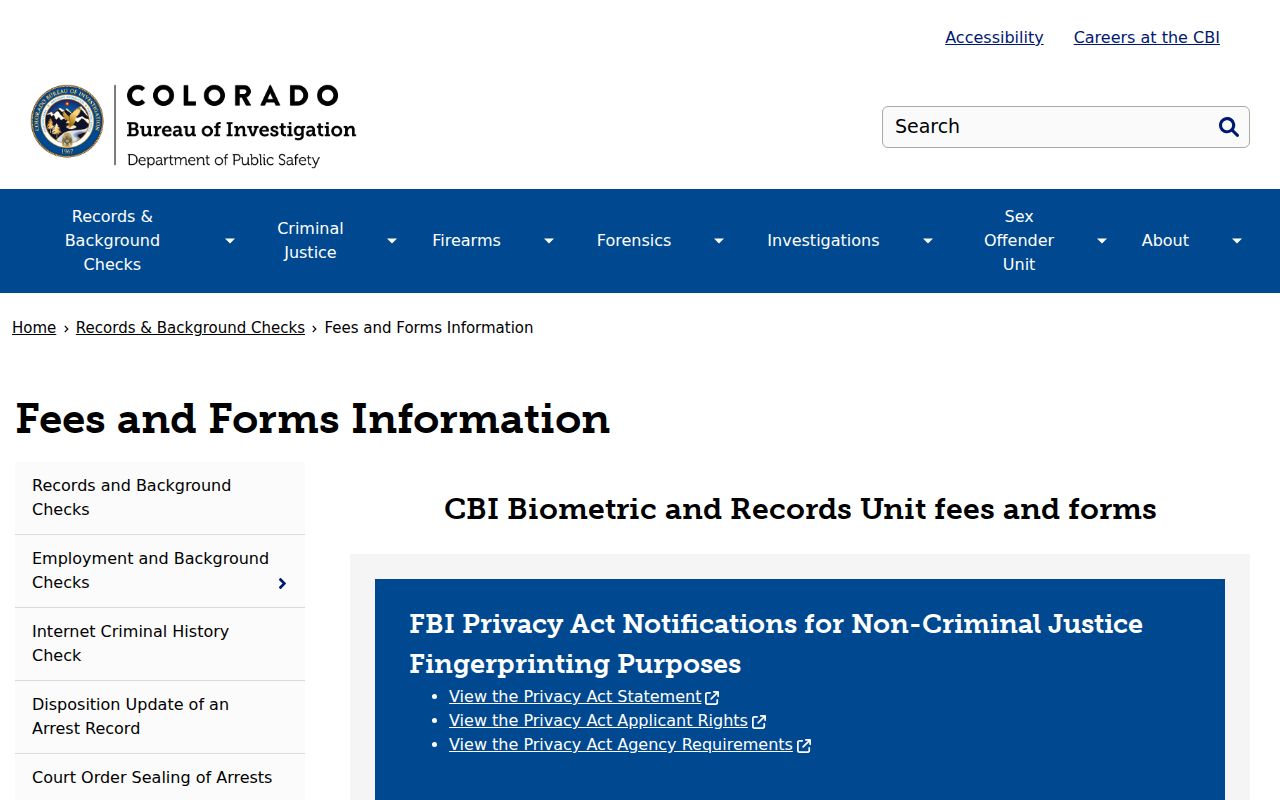
Those CBI prices apply to CBI products, not SCSO reports or Rio Grande booking copies.
Saguache Arrest, Del Norte Booking
The Saguache County Sheriff page, last updated July 25, 2024, states that county inmates are now held by the Rio Grande County Sheriff in Del Norte. That arrangement can split one event across two counties. SCSO may keep the incident and arrest report, while Rio Grande detention staff hold current booking, classification, appearance, release, and transport information.
Call SCSO first to identify the arresting agency, incident number, and booking destination. Then ask the Rio Grande official channel about current custody. The published county administration switchboard is 719-657-2744 at 925 6th Street, Del Norte, but research did not verify it as a jail-direct line. Ask to be routed rather than treating it as a dedicated inmate number.
Saguache County Arrest Lookups
No official Saguache arrest blotter, jail roster, warrant portal, records portal, or sheriff app was found. A complete lookup uses direct agency contact, the detention custodian, the court, and CBI. Give exact details. A date, location, incident number, and full name can prevent a broad search and help the custodian assess redactions.
- Call SCSO at 719-655-2544 to confirm the arresting agency, incident number, and custody destination.
- Contact Rio Grande County if the person may be held under the Del Norte arrangement.
- Search Colorado Judicial Dockets for a Saguache appearance, then request the complaint and ROA.
- Use CBI ICHC when a Colorado-wide name-based history is needed.
- Send a focused CCJRA request to the agency that holds the specific report or booking item.
Request Saguache Arrest Reports
SCSO does not publish a separate records manager, email, form, fee schedule, ID rule, or turnaround time. Use 719-655-2544, fax 719-655-2240, P.O. Box 265, or the counter at 530 5th Street, Saguache, CO 81149. Ask for requirements and a quote before ordering. CBI and court fees do not establish sheriff prices.
Saguache County Sheriff's Office
530 5th Street
Saguache, CO 81149
719-655-2544
Fax: 719-655-2240
A useful request names the incident or case number, date, time, exact location, involved person, arresting agency, and requested item. Specify whether you seek the arrest report, probable-cause narrative, citation or warrant reference, or releasable property record. Investigative parts may be withheld or redacted under the Colorado Criminal Justice Records Act.
Arrest Records: What They Contain
An agency report and a jail booking are not the same record. Exact public Rio Grande booking fields were not verified, so the table describes common functions supported by the research, not a promised online profile. Ask the custodian what can be released.
| Booking Number | A detention identifier, if assigned and released. |
|---|---|
| Booking Date & Time | The intake point, separate from the incident time. |
| Arresting Agency | The office that made the arrest and holds its report. |
| Charges | Initial booking allegations, which may differ from filed charges. |
| Bond | A release condition or hold status recorded at that stage. |
| Mugshot Policy | No verified local public photo policy was found; ask the custodian. |
| Release Status | Current custody or release information held by detention staff. |
Recent Saguache County Bookings
No comprehensive official daily blotter or Saguache roster was found. Occasional agency press releases are selected public statements. They cannot substitute for a booking log and should not be treated as a list of all arrests. Call SCSO and the current detention custodian for a recent event.
A missing custody result does not prove there was no arrest. The person may have been released, cited, transferred, held elsewhere, or booked under another agency. Search the Saguache docket for an appearance and contact the clerk when a filed case may exist. CDOC covers state prison custody, not county detention.
The official CBI CCJRA request policy illustrates that criminal-justice requests go to the actual custodian.
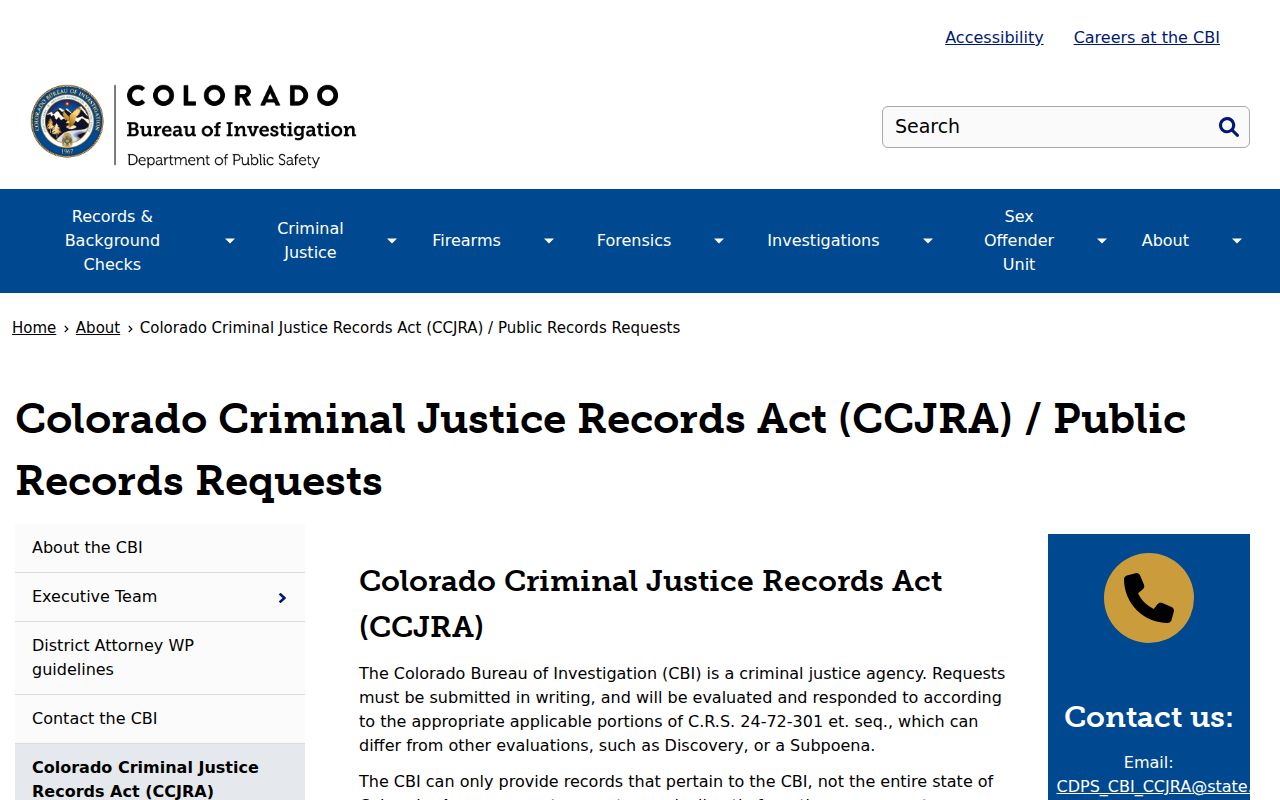
For a local report, direct the request to SCSO, Center Police, CSP, or the identified arresting office rather than CBI.
Saguache Booking Charges Can Change
The intake charge reflects the officer's basis at booking. A prosecutor can decline it, amend it, or file a different charge. Use allegation language until the court reaches a disposition. The complaint shows what was filed, while the disposition or sentence order shows how the case ended.
If no court case appears, confirm the date range and court location. An arrest can end without a filed prosecution. A municipal citation may also stay outside the state court path. Do not use a missing docket event as proof that no arrest or warrant existed.
The CBI sealing page explains repository handling after a court order.
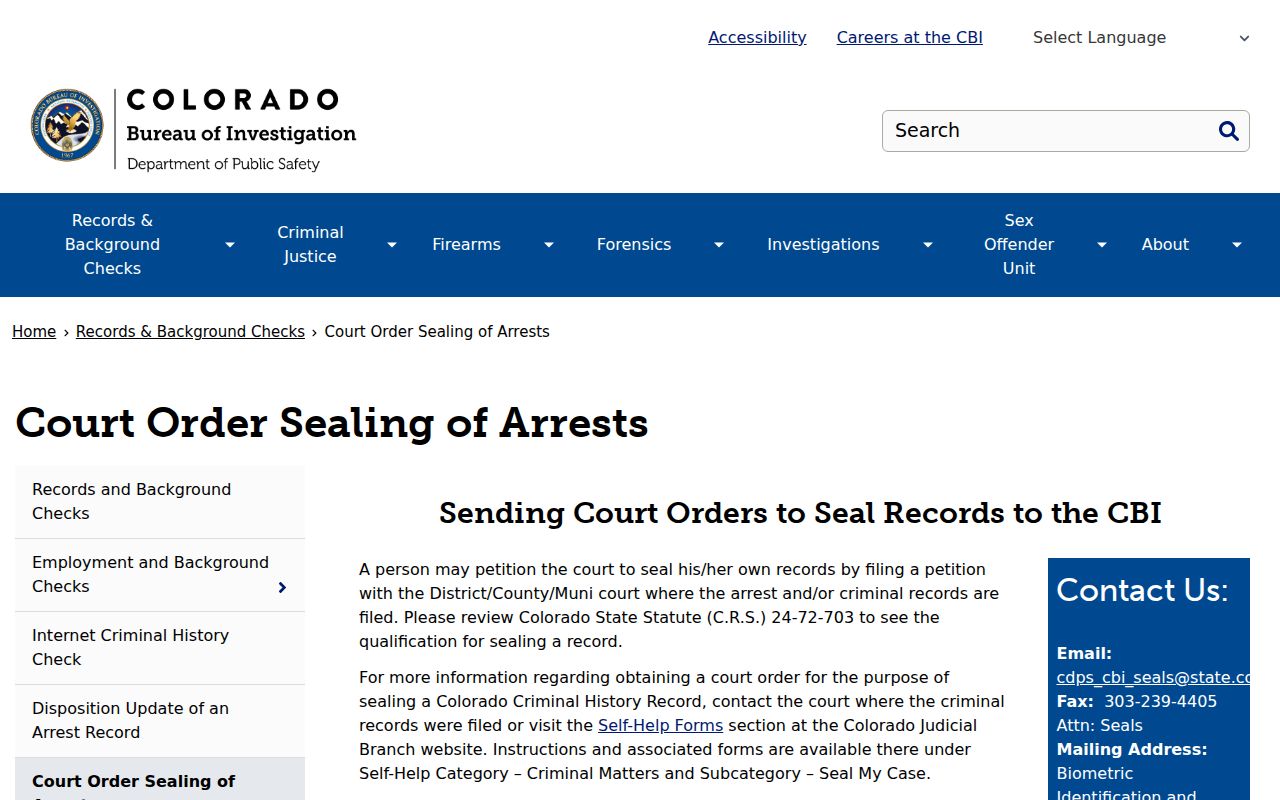
Dismissal and sealing are distinct. A dismissal changes the outcome; sealing limits ordinary public access after the legal process is complete.
Saguache Arrest Agency Roles
SCSO and Center Police create their own reports. Colorado State Patrol holds records for its arrests. Rio Grande detention maintains custody under the housing notice. Saguache Combined Court holds filed allegations and outcomes. CBI maintains the statewide repository. Sending one broad request to the wrong office delays the answer.
The Colorado Attorney General records overview distinguishes general public records from criminal-justice records governed by CCJRA.
The image supports the key routing rule: request the exact record from the agency that created or now maintains it.
Arrest Records vs Conviction Records
Arrest and conviction records come from different decisions and custodians. An officer and detention facility document custody. A court records the adjudication, meaning the formal result. CBI may aggregate reported arrests and dispositions, but its report does not replace the source file.
| Arrest Record | Conviction Record |
|---|---|
| Created by the arresting agency and detention staff | Created by the court after adjudication |
| Shows that custody or booking occurred | Shows a finding of guilt and judgment |
| Held with SCSO, another arresting agency, or Rio Grande detention | Held by Saguache Combined Court and reported to CBI |
| May be followed by release or no filed charge | May be followed by sentence, appeal, or sealing |
Note: An arrest is not proof of guilt; verify the outcome with the court's disposition or judgment.
When Saguache Custody Is Missing
If a person is not found through the current detention channel, verify whether the arresting agency released the person, issued a summons, transferred custody, or used another county. A later state sentence belongs in the CDOC locator, while a federal transfer belongs in the BOP locator. Neither replaces the local arrest report.
Check Saguache Combined Court for an appearance and ask the clerk for the complaint and ROA when charges may have been filed. Absence from one roster, calendar window, or repository is not proof that no arrest occurred. Keep the date, agency, location, and incident number together as the search moves between custodians.
Saguache Arrest to Court Timeline
The arresting officer first creates the incident and arrest material. If the person is detained under the county's published arrangement, Rio Grande staff handle intake, classification, housing, court transport, release, and related custody entries. Saguache County still remains the source for the sheriff report when SCSO made the arrest. This split explains why one phone call rarely supplies the whole record.
Next, the prosecutor reviews the event and decides what to file. An officer's booking charge is provisional. The Complaint or Information states the allegation that reached court. County Court handles an initial felony complaint and advisement. A felony prosecution then moves through District Court, while a misdemeanor normally stays in County Court. The ROA records hearings and orders in sequence. The disposition and sentence document the final court result.
Fingerprint-linked arrest data may also enter CBI's Colorado criminal-history stream. Courts report dispositions back to CBI, but a repository record may lag or display an unknown result. For review of your own record, save the CBI result, obtain the matching Saguache disposition, and use CBI's challenge or update process. The arresting agency cannot rewrite a judgment, and the court clerk cannot directly alter the state repository.
Record flow: Agency Report › Rio Grande Booking › Prosecutor Review › Saguache Court File › CBI Disposition Update
Saguache Arrest Access Boundaries
CCJRA treats official actions, including arrest, indictment, information, disposition, release, and probation or parole decisions, as open records. Investigative records receive a different review. A custodian may weigh disclosure, redact protected facts, or withhold material under applicable law. Victim information, medical data, juvenile material, personal identifiers, and an active investigation can limit what a requester receives.
Ask for a specific record and format. A request for the releasable arrest report, probable-cause narrative, citation reference, or booking status is clearer than a demand for everything about a person. Include the event date and location. If the office withholds or redacts material, ask it to identify the basis and explain any fee before work begins.
No verified SCSO fee, ID policy, or turnaround was published in the official sources reviewed. Do not substitute CBI's $6 online result fee or the court's per-page schedule. Each office charges for its own product. Written requests also create a useful record of what was sought, when it was sent, and which custodian answered.