
Center Criminal History Checks
Begin a Center record check with the paper already in hand. A summons, bond sheet, case number, or release paper may identify the county, arresting agency, and court. Without that clue, contact the Center Police Department and give the date, time, exact location, incident number if known, involved party, and specific record sought. The town publishes no police report portal, arrest log, or municipal case search.
Use a short sequence so each office answers the question it owns:
- Confirm whether the event occurred on the Saguache or Rio Grande side of Center.
- Ask Center Police for the incident or arrest report and a fee estimate.
- Ask Town Hall whether a citation belongs to Center municipal court.
- Search the correct county court and contact the receiving jail for custody data.
- Use CBI ICHC for the Colorado repository view, while recognizing its limits.
Center criminal records can diverge at the first step. A statewide check may bridge the county boundary, but it does not supply the local narrative or municipal file.
Which County Holds Center Records?
Center had 1,929 residents in the 2020 Census, with 1,885 in Saguache County and 44 in Rio Grande County. That split is operational, not merely geographic. The site of the event and filing choice can determine which county court receives a state case. A search filtered only to Saguache may miss a matter filed across the line.
Ask for the street address and the filing county. Then match the record type to its custodian. Center Police may hold the report regardless of which county later handles prosecution. A jail maintains booking and current custody. A court holds complaints, event indexes, orders, and outcomes. CBI aggregates reportable statewide arrest and disposition cycles. None substitutes for all the others.
Routing caution: The word “Center” alone does not identify the county, court, or detention custodian. Confirm the county side before relying on a no-result search.
Records at the Center Police Department
Center Police is located at 294 S. Worth Street, Center, CO 81125. The published department line is 719-754-3141, and emergencies go to 911. The official page also lists a chief cell, but that number should not be treated as a round-the-clock records desk. Start with the department line during town business hours. Town Hall shares the address and can be reached at 719-754-3497.
No official copy form, fee table, delivery schedule, or dedicated records email was found. A focused CCJRA request should state the incident number, date and time, exact location, involved party, requested document, and preferred format. Ask the custodian to explain redactions, expected cost, and delivery timing before work begins. Keep a written copy of the request.
The official source shows the office used for Center police contact:
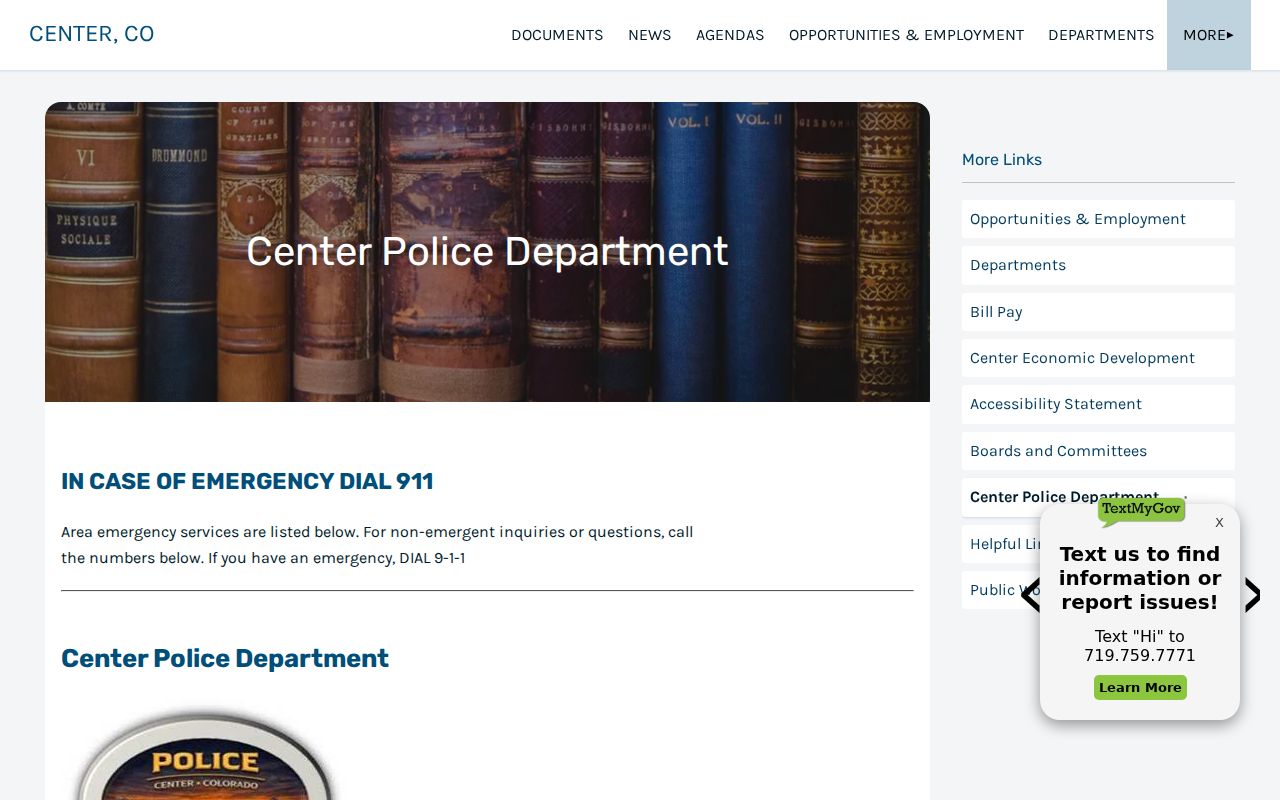
The image reinforces why the town channel is the first stop for a Center incident report, even when a later case belongs to a county court.
Center Incident Report Requests
An incident report describes what officers were told, observed, and investigated. An arrest narrative may state probable cause, yet it remains an allegation. Requesting the report by a broad name alone can cause delay, especially when the event crosses jurisdictions. Give the narrowest facts available and name the part sought, such as the narrative, citation reference, or releasable arrest information.
Center publishes no all-purpose portal. Direct contact is therefore the verified route. Under Colorado criminal-justice access law, some official actions are open, while active investigative material can be withheld or redacted after a custodian review. Victim data, juvenile information, medical facts, and protected identifiers may also be removed. A denial or partial release should identify the basis used.
Note: Center Police report fees and response times were not published, so request a written estimate instead of applying another agency’s prices.
Booking and Arrest Records in Center
Center advertises no municipal jail. After a Center arrest, identify the arresting agency and destination rather than assuming Saguache County custody. On the Saguache side, the county sheriff page says Saguache detainees are now held by the Rio Grande County Sheriff in Del Norte. An event on the Rio Grande side may follow a different filing and custody route.
A police arrest report and a booking sheet serve different purposes. The report records the police action and alleged basis. The receiving facility records intake, holds, bond, classification, court appearance, and release. The prosecutor may later amend or decline the initial charge. For a broader county explanation, use the Saguache County arrest search, then return to the named agency for the underlying document.
If a person is not found through a custody channel, do not infer that no arrest occurred. Release, transfer, citation without booking, or custody in another county can explain the gap.
Tracing a Center Arrest
A practical reconstruction starts with the Center Police incident number. Ask where the person was taken and which court received the first paperwork. Next, contact that detention custodian for booking status. Search the proper court for a scheduled hearing, then request the complaint and disposition when those documents exist.
Center arrest trail: Center Police › receiving jail › correct county court › Colorado Bureau of Investigation.
The trail may stop early. A release or municipal citation may not create a jail record. A non-fingerprinted event may not form a CBI arrest cycle. A dismissed case still can leave an arrest report and court file unless sealing applies. Read each no-result in light of the source’s scope.
The Center Municipal Court File
Center Town Hall is the direct channel for ordinance and municipal citation records because no public municipal lookup was located. Ask whether the matter is a town citation or a state criminal case. State misdemeanors and felony proceedings belong in the correct county’s judicial system, while local ordinance matters may remain with the municipality.
| Court Name | Center municipal court through Town Hall |
|---|---|
| Case Types Heard | Town ordinance and municipal citation matters; confirm the exact charge with the clerk |
| Case Lookup Channel | Direct request to Town Hall at 294 S. Worth Street, 719-754-3497 |
| What the File Shows | Citation, scheduled municipal events, orders, and outcome when maintained and releasable |
| Copies & Fees | No municipal fee schedule was found; request current terms and an estimate |
Town hours published in the research were Monday through Thursday, 7 a.m. to 5 p.m., and Friday, 8 a.m. to 1 p.m. Confirm them before visiting because municipal schedules can change.
Center Docket County Filters
The Colorado Judicial Branch Docket Search is free and useful for scheduled state court appearances. It is not a full case-document search. A Center searcher must select the county and court that actually received the case. On the Saguache side, use the 12th Judicial District, Saguache County, and Saguache Combined Court, then choose County or District Court as appropriate.
County Court handles misdemeanors and initial felony complaints. District Court handles felony prosecutions. Results show calendar information, not the complaint, full register of actions, evidence, or final outcome. For those records, submit the Judicial record request form to the correct clerk.
Note: A blank Center docket search does not prove that no citation, arrest, warrant, sealed file, or other-county case exists.
How Center Records Reach the County
A Center event begins with the agency record. If the allegation is prosecuted under state law, the complaint and court events arise in the county selected by location and jurisdiction. Fingerprint and disposition reports may then enter the state repository. Municipal ordinance matters can remain with the town and may not resemble a statewide criminal-history cycle.
Record flow: Center Police › Saguache or Rio Grande court › Colorado Bureau of Investigation.
The CBI Internet Criminal History Check costs $6 per viewed result and covers Colorado public name-based CHRI. It cannot replace the Center report, booking narrative, municipal citation, or actual court pleading. It also excludes sealed arrests and other categories described by CBI. Common identifiers may yield more than one paid result.
Center Records Without One Portal
The lack of a single Center search tool is a feature of record ownership. Police, town, jail, court, and repository staff create records for different legal and operational tasks. Combining them gives a more accurate sequence than treating one database as complete.
Use the incident report for the local account. Use the booking custodian for present or past intake facts. Use the municipal clerk for town citations. Use the court complaint and disposition for filed allegations and outcomes. Use ICHC for the public statewide repository view. If the ICHC outcome conflicts with the court order, obtain the official disposition and follow CBI’s correction process.
A name match is not positive identification. CBI identifies fingerprints as the only positive repository identity link. This point matters in a town whose county route is already easy to confuse.
Center Record Access Rules
Colorado separates general public records from criminal-justice records. Police incident, arrest, and investigative material generally falls under CCJRA. Court records follow Judicial Branch access rules and Chief Justice Directive 05-01. The office holding the original record decides what it can release and what must be withheld or redacted.
Key Statutes:
Colorado Open Records Act, CRS §§24-72-200.1–205 governs general state and local public records.
Colorado Criminal Justice Records Act, CRS §§24-72-301–309 governs criminal-justice records and treats arrests, charges, dispositions, and release decisions as official action.
CRS §24-72-305.5 permits an affirmation concerning direct business solicitation for pecuniary gain.
Ask for a written reason when access is limited. A redacted report can still be the correct lawful response. Sealed, juvenile, victim, medical, and active-investigation material may not be available through ordinary public channels.
Center State History Mismatches
A Center court result and a CBI history can disagree because they are maintained by separate custodians. Start with the document that states the judicial outcome. On the Saguache side, request the Disposition/Sentence Order from Saguache Combined Court and include the year, case class, sequence, party name, and date of birth if known. For a case filed on the Rio Grande side, use that county’s court channel instead. Keep the paid ICHC result so the precise arrest cycle and missing or incorrect field can be identified.
Next, compare the agency, date, charge, case number, and disposition across the two records. CBI directs a subject who finds wrong information or an unknown outcome to obtain official court or agency documentation and use its record-challenge process. Center Police cannot rewrite a court judgment. A county clerk also cannot promise that CBI has already updated the repository. Verify the corrected court file and the later repository result separately.
A dismissal creates another common Center records puzzle. It changes the case outcome, but it does not automatically erase the police report, booking entry, court file, or CHRI line. Colorado provides routes for sealing eligible non-convictions and convictions. A sealing order must reach each named custodian before ordinary public access changes. The town’s two-county setting makes that custodian list especially important.
Note: Keep receipts and copies from each Center records office because fees and release rules belong to the specific custodian, not to the town as a whole.